Documentation
FounderSignal Quickstart
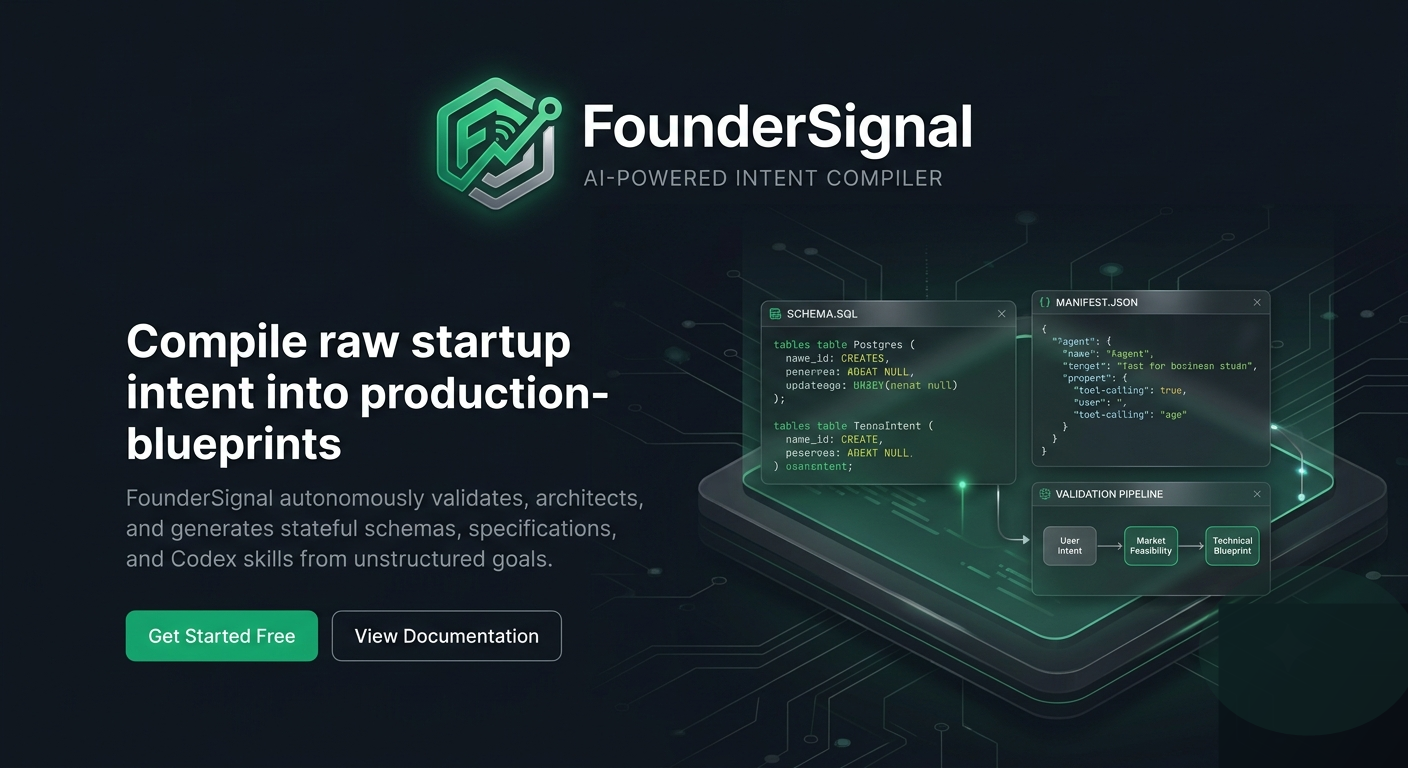
FounderSignal converts founder intent into a repeatable execution packet. Start by sending the idea, target customer, validation score, known risks, and any founder corrections to the compiler endpoint. The compiler returns four artifacts: spec.md for product requirements, schema.sql for Supabase PostgreSQL with RLS, tasks.txt for a Codex goal loop, and manifest.json for reusable workflow packaging.
The recommended flow is simple. First, run the Agent Loop to capture the founder hypothesis and pressure-test it through market, technical, and growth lenses. Next, open the Codex Brief and compile the artifact set. If the founder disagrees with any assumption, apply a correction. FounderSignal treats that correction as a regression check, not a note. The output is recompiled so the new constraint appears across the spec, schema, task list, and manifest.
After artifacts are ready, use the Vault Handoff route to create a session commit. The public Build Week version uses deterministic fallbacks where private model keys are unavailable, but the contract is production-oriented: API routes are typed by behavior, Supabase policies are explicit, and artifacts are machine-readable enough for Codex or another AI IDE to continue the work.
API
curl -X POST https://foundersignal-buildweek.vercel.app/api/compile-brief \
  -H "Content-Type: application/json" \
  -d '{"idea":"AI workflow","customer":"B2B founders","score":88}'
Correction Loop
Use /api/refine-artifacts when a practitioner adds a constraint. The response includes updated artifacts and a previous response identifier for state continuity.
System Architecture
FounderSignal is Codex-first. The platform treats OpenAI Codex as the execution reasoning layer, not a typing assistant. Founder input is normalized, scored, challenged by specialist agents, compiled into artifacts, refined through correction loops, and committed through the Vault handoff. The architecture is documented in SYSTEM_ARCHITECTURE.md.
The repository also includes a Vercel eve-style agent directory at eve-agent/, plus a public manifest at /api/eve-manifest. It demonstrates the production agent shape: agent.ts, instructions.md, tools/, skills/, channels/, schedules/, and subagents/.
Public demo metrics intentionally avoid unverified scale claims. The live proof focuses on verifiable artifacts, deployed routes, Vercel Cron, API responses, and the agent directory contract.
Vault Handoff
Use /api/vault-commit to serialize the session into a commit record with a session id and content hash.